Dr. Laura Thomas, Science Communicator for JSAR / The Mars Society
4 min read
What is a Space Analog?
When most people picture astronaut training, they imagine high-tech simulators, zero-gravity flights, or floating aboard the International Space Station. However, some of the most important preparation for living on the Moon or Mars doesn’t happen in orbit at all. It happens here on Earth, during space analog missions.
Space analog missions act as a kind of dress rehearsal for space. They replicate the key challenges of a mission environment such as isolation, confinement, and limited resources.
Recent research published in Frontiers in Space Technologies describes two main types of analog environments.
The first are known as Isolated, Confined, and Extreme (I.C.E.) environments. These include remote places such as polar research stations or subterranean settings, where people face harsh environmental conditions, limited rescue options, and long periods of isolation. These sites are considered ‘extreme‘ because they expose crews to many of the same psychological and physical challenges found in space. Additionally they can pose serious and immediate danger to life.
The second type are Isolated, Confined, and Controlled (I.C.C.) environments. These are purpose-built habitats and simulators that recreate mission conditions in a more controlled manner, where extraction is easier. Examples include NASA’s Human Exploration Research Analog (HERA) and other specialized training facilities. In these settings, scientists can study how small crews live and work together under strict routines, limited privacy, and communication delays, all without leaving Earth.
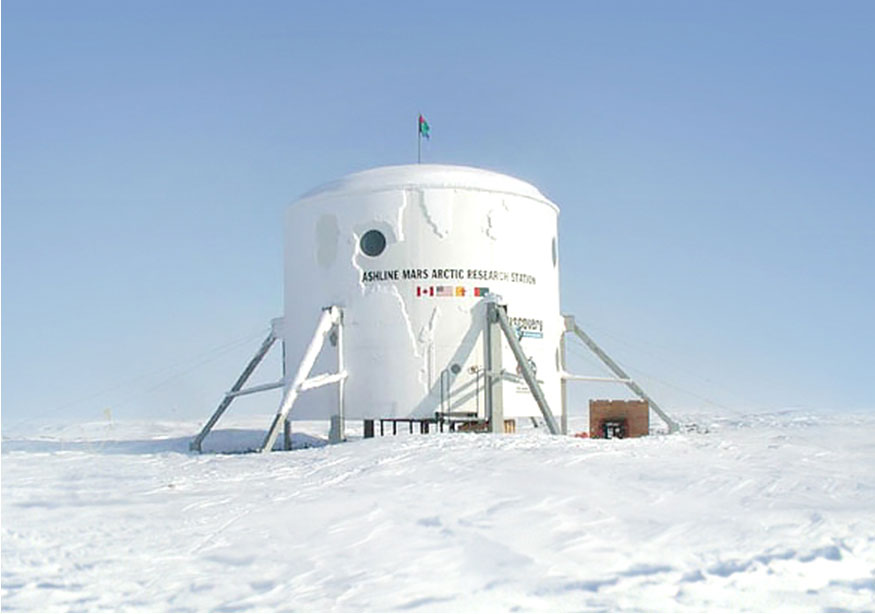
Both analog types have their strengths. I.C.E. sites provide real-world stressors and high levels of fidelity, whereas I.C.C. habitats allow for structured testing and replicability. The Mars Society contributes to both approaches through its analog stations, using the Mars Desert Research Station (MDRS) and the Flashline Mars Arctic Research Station (Flashline) to help prepare humans for life on the Moon and Mars.
Simulating Space on Earth
For more than two decades, The Mars Society has been at the forefront of analog research. The organization operates two of the world’s most active field stations: MDRS in Utah’s San Rafael Swell and Flashline on Devon Island in Nunavut, Canada.
At these sites, crews live and work in conditions that closely mirror the challenges of planetary exploration. They conduct ‘Mars-walks‘ in simulated spacesuits, ration water and power, and operate within a closed-capsule setting. Each rotation is both a test of technology and a study of human behavior.

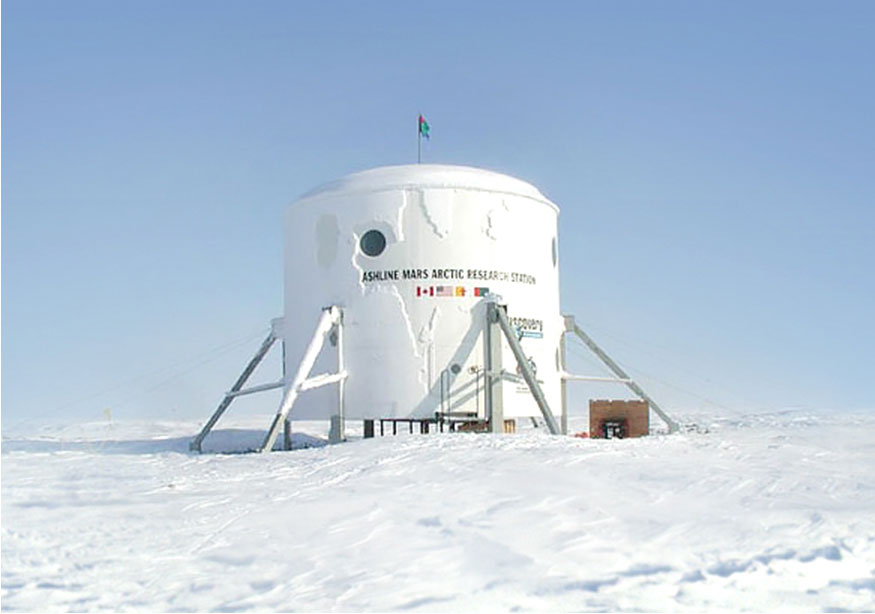
Moreover, analog stations like MDRS and Flashline help bridge science and lived experience. They give scientists, engineers, and medical researchers a place to test life-support systems, field protocols, and decision-making strategies long before a real mission launches.
Global Efforts in Analog Research
Analog missions are part of a wider, global effort to prepare humanity for interplanetary living. For example, the Mars-500 study remains the longest simulation ever conducted. It took place at the Institute for Biomedical Problems (IBMP) in Moscow as a collaboration between Roscosmos, the European Space Agency (ESA), and the China National Space Administration (CNSA).
During this 520-day study, a six-person crew lived in a sealed habitat that simulated a full round trip to Mars. The mission included progressive communication delays, distinct operational phases, and a 30-day simulated surface stay.
As a result, scientists gained valuable insights into the psychological, physiological, and operational demands of deep-space travel. The study revealed patterns of chronic sleep disruption, motivation decline, and interpersonal tension, findings that continue to inform psychological countermeasures and crew support strategies in modern spaceflight.
Why Space Analogs Matter
When humans eventually build a base on the Moon or step onto Mars, much of that success will rest on the foundations being laid right now in space analog missions on Earth. These simulations are more than technical exercises; they serve as training grounds for human adaptability, leadership, and teamwork.
Every mission at MDRS or Flashline deepens our understanding of how people live, lead, and perform in isolated, confined, and extreme environments. Ultimately, what we learn in these habitats will help transform today’s experiments into tomorrow’s capability for sustained off-world living.