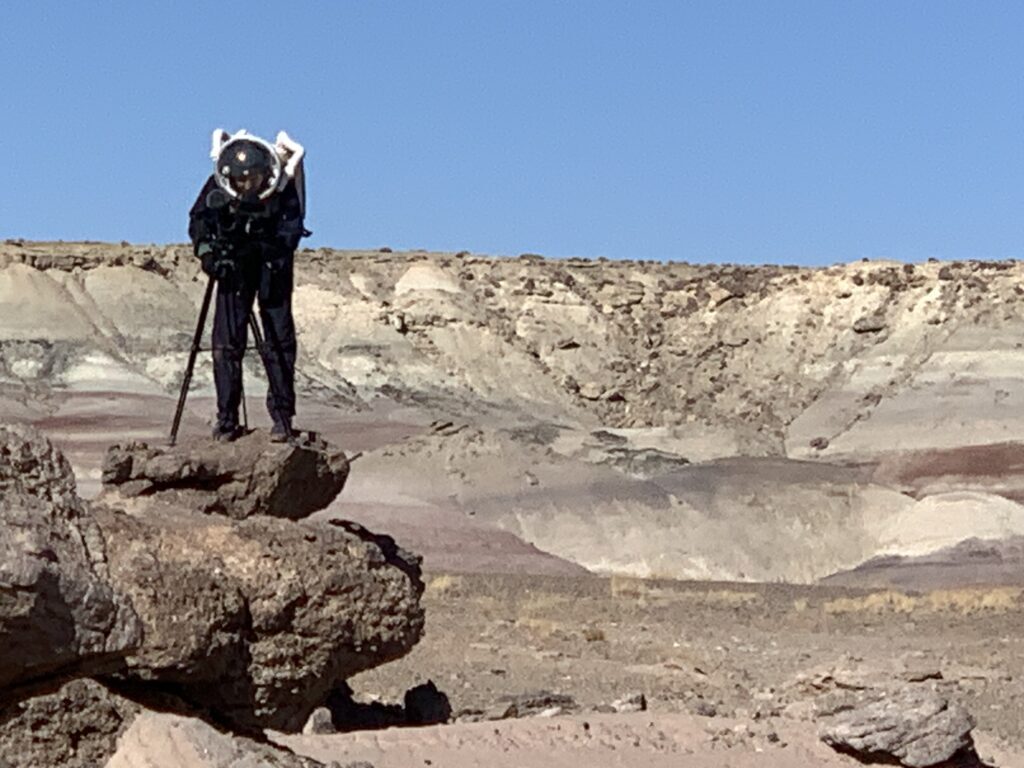
Crew 286. Photo courtesy of The Mars Society.
Lauren Wright, Volunteer for JSAR / The Mars Society
3 min read
At the Mars Desert Research Station (MDRS), crews quickly learn that mission success depends on far more than science experiments. Daily life inside the habitat revolves around the constant monitoring and documentation of critical systems, power generation, water storage, fuel levels, and environmental conditions.
Operations Reports from the 2023–2024 field season make this visible in concrete terms. For example, the Operations Report dated November 19, 2023 (Crew 286, 2023–2024 Field Season) includes detailed entries tracking water consumption, static tank levels, generator status, and heater usage. These reports do not simply summarize the mission; they log the technical health of the station in measurable terms.
This pattern continues across seasons. In a February 2024 Operations Report (2023–2024 Field Season), daily habitat status data is again documented alongside mission activity, reinforcing that systems oversight is an ongoing responsibility rather than a background task. Water usage, fuel status, and infrastructure checks are recorded systematically, underscoring the disciplined operational culture required in isolation.
These entries show that habitat management is not abstract. It involves daily verification of essential life-support infrastructure, ensuring that water levels are sufficient, heating systems are functioning, and energy resources are stable. Even when nothing fails, crews must prove that nothing is failing.
What stands out is how closely technical oversight and mission objectives are intertwined. Crews do not just monitor systems; instead, they monitor systems while conducting research. Habitat stewardship runs in parallel with EVAs, scientific sampling, and communications.
For future Mars missions, this reality is significant. Astronauts will not operate in an environment where infrastructure can be assumed. They will need to interpret data, log conditions, and respond to fluctuations while maintaining mission timelines. MDRS demonstrates that redundancy, cross-training, and procedural discipline are not optional features of long-duration missions. They are foundational.
Life on Mars will depend on crews who can sustain complex systems methodically and consistently, not only when problems arise, but every single day.